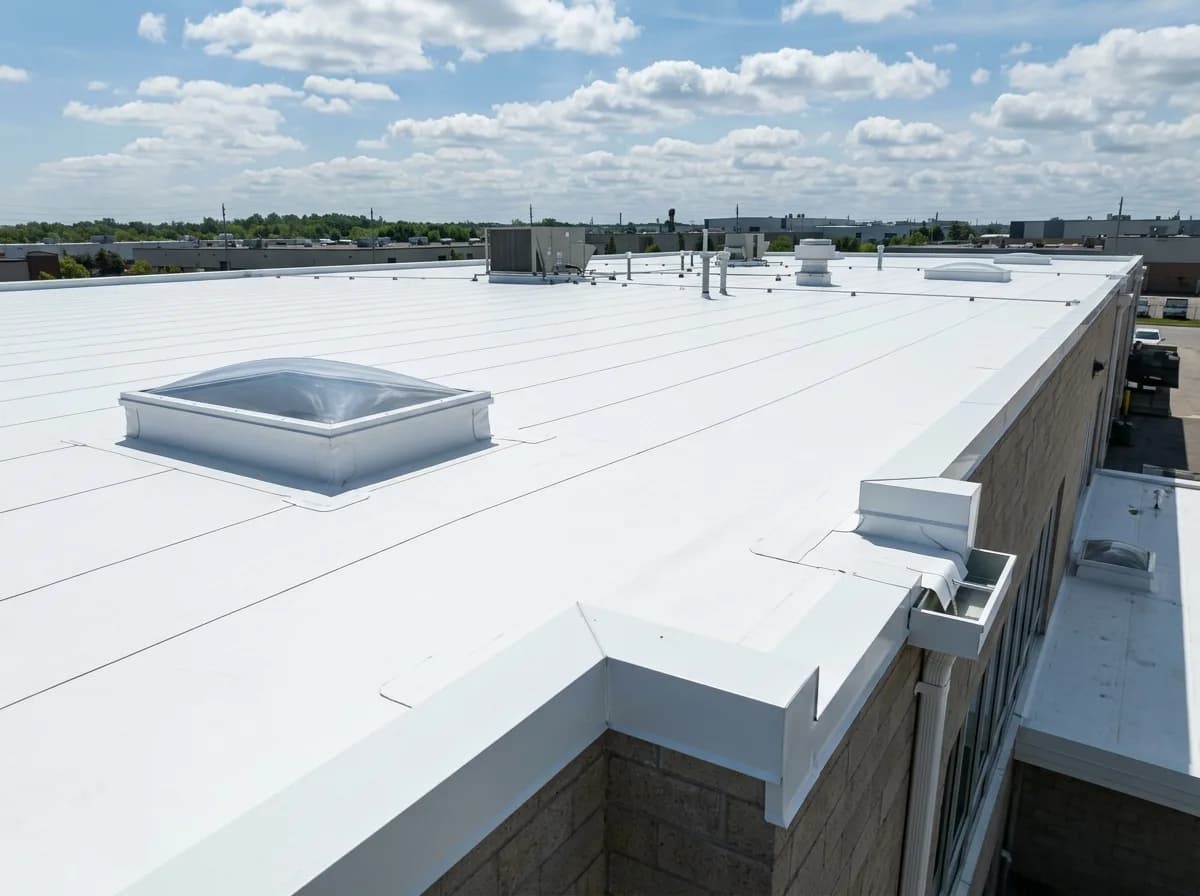
Key Takeaways & Executive Summary
- Researched strictly against Ontario Building Code (Part 9 & Part 4) engineering minimums for Southwestern Ontario.
- Considers Lake St. Clair and Lake Erie convective microclimate effects, wind shear, and freeze-thaw cycles.
- Verified contractor standards: Insist on active WSIB clearances and minimum $2M–$5M commercial general liability.
For commercial property managers, industrial plant operators, and retail plaza owners in Windsor and Essex County, selecting the right flat roofing membrane directly impacts operational overhead, tenant satisfaction, and long-term asset value.
The two dominant single-ply flat roofing membranes specified in Southwestern Ontario are Thermoplastic Polyolefin (TPO) and Ethylene Propylene Diene Monomer (EPDM). While both provide dependable waterproofing, their chemical formulations, seam joining technologies, and thermal profiles differ significantly.
In this guide, we analyze the performance of TPO versus EPDM across Canadian weather extremes to help commercial asset managers make informed capital decisions.
1. Overview Comparison: TPO vs. EPDM
| Specification Category | TPO (Thermoplastic Polyolefin) | EPDM (Synthetic Rubber) |
|---|---|---|
| Primary Color | Bright White (Reflective) | Matte Black (Heat-absorbing) |
| Seam Technology | Robotic Hot-Air Welded (Monolithic) | Primer & Self-Vulcanizing Tape |
| Solar Reflectance (SRI) | High (78+ SRI / Cool Roof) | Low (Warm roof / Absorptive) |
| Low-Temperature Flexibility | Good (down to -35°C) | Outstanding (Flexible at -45°C) |
| Chemical & Grease Resistance | Superior (Resists oils & fats) | Moderate (Can swell with oils) |
| Puncture & Tear Resistance | High (Internal polyester scrim) | High (Heavy elongation memory) |
| Average Service Lifespan | 22 – 30 Years | 25 – 35 Years |
| Repair & Restoration | Thermoplastic weld or coating | Tape patches or fluid silicone |
2. Seam Technology: Molecular Welds vs. Chemical Adhesives
On any flat roof assembly, the membrane field rarely fails; 90% of flat roof leaks occur along seams, curbs, and penetrations.
TPO’s Hot-Air Robotic Welds TPO sheets are welded together using automated robotic hot-air equipment that heats overlapping membrane edges to roughly 500°C before pressing them together with weighted rollers. - **Monolithic Molecular Fusion**: The melted plastic polymers fuse together into a continuous molecular bond that is measurably stronger than the surrounding sheet. - **No Glues to Deteriorate**: Because heat-welded seams contain no adhesive solvents or tapes, they cannot dry out or delaminate when subjected to seasonal ponding water.
EPDM’s Primer & Butyl Tape Laps EPDM is a thermoset vulcanized rubber, meaning it cannot be melted and re-welded with hot air. Instead, seams are joined using specialized solvent-based primers and double-sided cured butyl seam tape. - **High Elasticity**: Taped seams handle building structural movement and expansion remarkably well. - **Vulnerability to Stagnant Water**: Over decades, continuous standing ponding water or grease discharge can gradually soften adhesive tapes, necessitating proactive seam maintenance.
3. Climate Performance: Summer Solar Reflectance vs. Subzero Elasticity
Windsor’s unique climate swings from scorching, humid 35°C July heatwaves to subzero January freezes.
The Case for TPO in Summer (Cool Roof Benefits) - **Massive Solar Reflectance**: White TPO membranes reflect over 75% of solar infrared rays away from the roof surface. While a black roof can reach 70°C on a summer afternoon, a white TPO roof remains close to ambient air temperature. - **Lower Air Conditioning Bills**: In multi-tenant retail plazas, offices, and distribution centers, reduced roof heat transfer dramatically lowers cooling electricity loads and extends the operational life of rooftop HVAC compressors.
The Case for EPDM in Winter (Subzero Resilience) - **300% Elongation Flexibility**: EPDM synthetic rubber maintains its rubbery elasticity at temperatures down to -45°C. When commercial buildings contract during bitter winter freezes, EPDM stretches and recovers smoothly without developing brittle hairline stress fractures. - **Snow Melt Benefit**: In non-air-conditioned warehouses or industrial buildings that require heating through winter, a dark black EPDM membrane absorbs winter sun, accelerating snow and ice melt off the roof surface.
4. Restaurant & Manufacturing Considerations: Chemical Resistance
If your commercial property houses restaurants, bakeries, food processing lines, or manufacturing exhaust fans: - TPO is the Clear Winner: TPO is naturally resistant to animal fats, vegetable oils, petroleum hydrocarbons, and chemical rooftop emissions. - EPDM Warning: Standard EPDM rubber swells, softens, and degrades when exposed to continuous animal grease or petroleum exhaust unless specialized resistant formulations or grease containment guards are installed around exhaust fans.
5. Summary Recommendation for Commercial Property Owners
- Specify TPO if: Your facility has high summer air conditioning costs, houses restaurants or light manufacturing with rooftop exhaust, features extensive HVAC rooftop equipment, or requires heat-welded monolithic seams.
- Specify EPDM if: You manage a large unconditioned warehouse, prioritize long-term subzero winter elasticity, have a building with significant thermal structural expansion, or operate on a ballasted rock assembly.
*Need an expert condition assessment or quote for your commercial facility? Explore our Commercial TPO Roofing and Commercial Flat Roof Repair services, or contact our commercial team directly at Windsor Roofing Pros.*
Article Topics:
Windsor Roofing Pros Technical Editorial Team
Staff SpecialistCommercial Systems Director
The technical editorial team at Windsor Roofing Pros provides objective, code-compliant roofing analyses for residential homeowners and commercial building stakeholders in Essex County, Ontario.